
UNIT-D
Deterministic Generative Sequencer
UNIT-D turns geometry into music: it creates a seeded 2D cloud of nodes, connects points using a distance rule, and turns graph traversal into pitch, gates, accents and X/Y modulation.
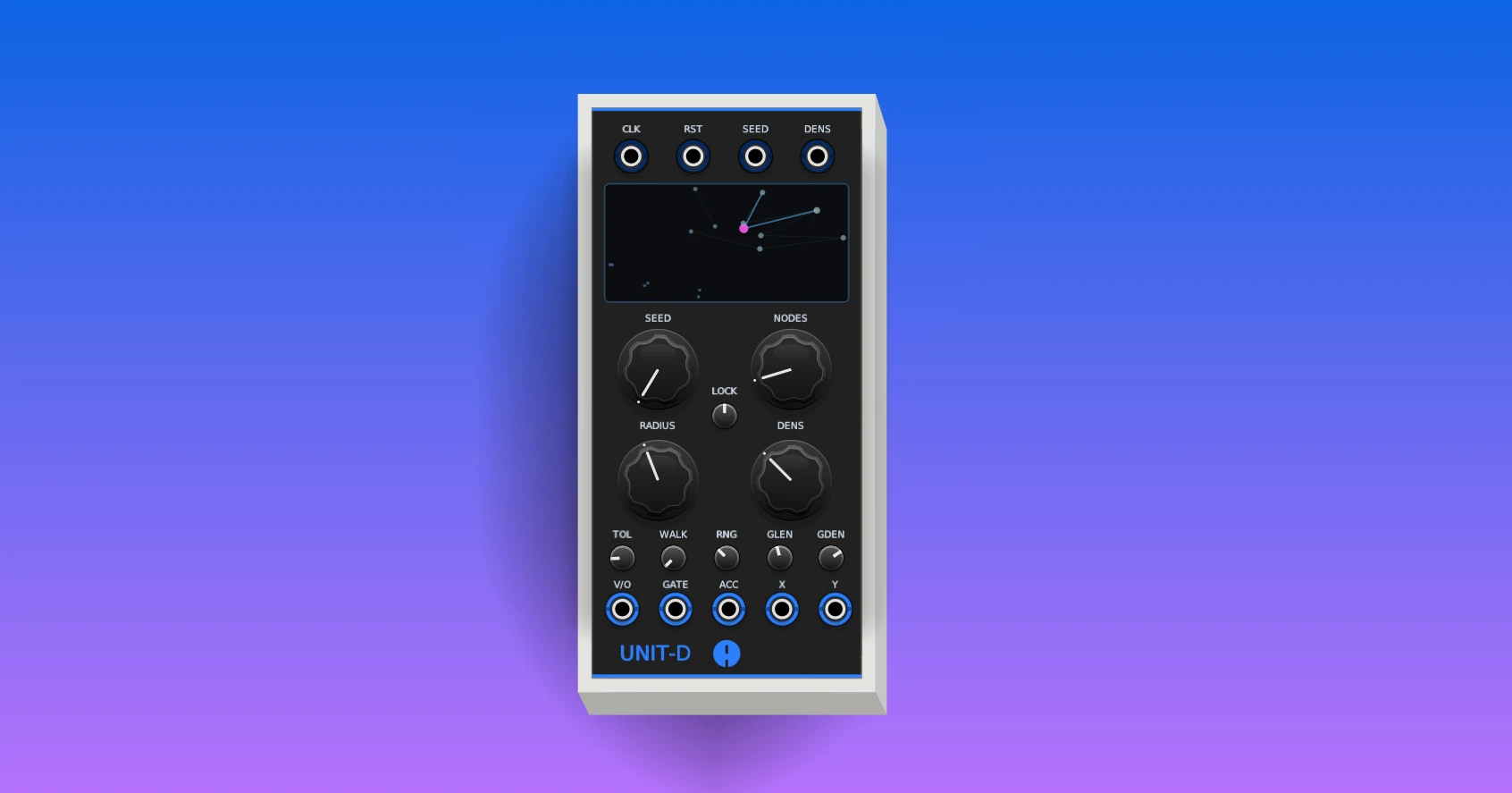
It is not an uncontrolled random source. With the same seed and the same settings, UNIT-D repeats the same structure, so you can explore living patterns without losing the ability to return to a phrase.
It is built for generative melodies, semi-repetitive modular lines, counterpoint, polyphonic material and patches where pitch, accent and modulation come from one shared logic.
Musical concept
Points = musical states
Each graph node represents a possible note or pattern state.
Lines = transitions
Connections define where the walker can move on each clock pulse.
X/Y as modulation
Node position generates related voltages for timbre, filters, FM, decay or any CV destination.
Density as energy
The number of connections controls accents, movement and musical complexity.
Gradual LOCK
Progressively freezes 16 or 32-step phrases, forward or reverse.
Polyphony
Context-menu polyphony from 1 to 8 voices, with shared seed or per-voice graphs.
Quick manual
Quick start
Patch clock to CLK, V/O to an oscillator, GATE to an envelope, ACC to amplitude/filter, and X/Y to timbral parameters.
Shape
SEED, NODES, RADIUS, TOL and DENS define the base geometry.
Traversal
WALK, LOCK, GDEN and GLEN define how that geometry is played over time.
Musical reading
RNG, V/O, ACC, X and Y decide how traversal becomes sound.